Showing posts with label loss. Show all posts

Sunday, September 25, 2011

Travelling Through Time

Picture found on: favim.com
“Everyone has a time machine. Everyone is a time machine. It’s just that most people’s machines are broken. The strangest and hardest kind of time travel is the unaided kind. People get stuck, people get looped. People get trapped. But we are all time machines. We are perfectly engineered time machines, technologically equipped to allow the inside user, the traveler riding inside each of us, to experience time travel, and loss, and understanding. We are universal time machines manufactured to the most exacting specifications possible. Every single one of us.” - Charles Yu, How to Live Safely in a Science Fictional Universe
This is my new favourite quote. I've even dedicated a space for it on my Facebook profile page under "quotations". (So you know I am very serious). I'm not exactly sure why I have taken such a strong liking to it. I suppose it is because of the grand scale of nostalgia and loss that it represents metaphorically.

We have all experienced the unusual wave of nostalgia from time to time. Sometimes it's pleasant; sometimes it overwhelms us with a terrible sadness. And sometimes it takes us to the point where we are convinced the past is infinitely better than the now. But whatever reasons we have for holding onto the past, the underlying rationale is clear. The past is comforting; is uncomplicated; is familiar. Sadly, some of us get stuck in our time machines, constantly looped in way that is dangerous to our well-being...

Time machines weren't created simply for the purpose of staying in one place and they don't get stuck on their own. We all have the relevant mechanisms built within us to move forward. That's the glorious thing about time travel. There are buttons and formulas to take us to the present. And all it takes for us is to push them.  Not technically into the future (although, as I hold many questions about mine that would be a completely fantastic trait for the machine to have!), but away from the past and into better times.

*Speaking of machines that allows one to travel, I'm about to hop on a plane to Melbourne! I have my fingers and toes crossed that this city will bring with it delicious food, fantastic shopping, and hopefully... a great future! Wish me luck!

Sunday, September 11, 2011

The Decade of Magical Thinking

Picture found on: therumpus.net


Here is an article I wish to share with you about 9/11. This piece is bold, thought-provoking and brave for an American writer to put into print. It also puts into perspective what we have learnt about humanity since the events 10 years ago. Warning: Highly political and may offend some readers.
"A Rumpus Lamentation on What We Lost

Say you took the long view of September 11, 2001, the view from the heavens, the view of a compassionate celestial being. From up there, you’d see that approximately 150,000 earthlings died that day. Most of these deaths were caused by malnutrition and age-related illnesses, roughly 1500 were murders, hundreds more were due to civil wars. Also, 2,977 Americans were killed in terrorist attacks on New York City and Washington.

A lot of human beings died, that’s my point. They all left behind mourners.
Imagine the mother who watched her child die of hunger. Here’s this tiny person, a daughter. She has a name, a face. She doesn’t explode or fall from a skyscraper. She simply stops breathing. No cameras record her final moment, the lamentation of that mother. These images are not replayed on the television over and over and over. What would be the point of that?

I recently went on a radio program to discuss the literature of 9/11. The host spent most of the hour chatting with people about their memories. They all talked about watching television. They were telling personal stories about watching television.

One of the duties of the artist – not the only duty, but a central one – is to impel people to imagine the complexity of thought and feeling inside another person. Art complicates moral action, because we have to accept that other people matter, that their hardship and suffering, even their rage and sorrow, are, to some extent, our responsibility.
Propaganda has the opposite aim: it is intended to simplify moral action. People get to disregard the humanity of others. This makes them easier to ignore, deport, imprison, torture, enslave, and kill.
...
At one point on this radio show, a TV producer discussed his decision to stop showing footage of the attacks. The host said she wanted to see those images; that she wanted to remember what had happened and how she’d felt. She was glad networks were going to re-broadcast that footage in the next few days. She added that didn’t want to see people jumping to their deaths, just the towers falling.

...
If one of my relatives had died that day …
But, you see, none of them did. It felt fraudulent to me to appropriate the emotional life of those in mourning, to pretend those atrocities were something personal, to rhapsodize about national unity. What I felt was dread, a sense that my country was going to respond precisely as the terrorists intended: by becoming less human.
I visited a friend a week after the attacks, a good-hearted fellow who spent a lot of his time and money establishing a school for at-risk kids. He told me that he didn’t know exactly who’d done this to us, but that he wouldn’t mind seeing Uncle Sam drop a few hundred bombs on them. He looked down as he said this, because he knew, I think, that it was a shameful thing to say, that he was calling for other human beings to be killed, not because they had harmed him, or his family, but because they had harmed his sense of omnipotence.
...
Nobody stood up – in Congress, in the bright studios of our corporate media, in city hall – to make the obvious point that millions of people in other parts of the world live in a state of perpetual danger. And that the events of 9/11 might therefore require of us a greater empathy for those suffering elsewhere, might even nudge us toward a more serious consideration of our own imperial luxuries and abuses, and how these might relate to the deprivations suffered in less fortunate precincts.
That’s not what we talked about. No, we talked about our feelings. Americans were bloated with empathy in the weeks after 9/11. But something fatal was happening: as a nation, we were consenting to pursue vengeance over mercy. We were deciding – with the help of all that deeply feeling propaganda on our television sets – that the only human suffering that mattered was American.

The tragedy of 9/11, then, wasn’t that 2,977 people died. It was that 2,977 Americans died.
...
Freud and others were fascinated by the concept of “infantile omnipotence.” This is what a child feels early in his life, and what he must eventually surrender, when he realizes he does not, and cannot, control the world.

There are some people, though, who can never quite accept this truth. They don’t have a strong enough sense of self to sustain the psychic injury. And thus, they resort to magical thinking, delusions of grandeur, angry projections, wild superstitions. They become, in this sense, more closely aligned with primitive cultures.
It is my belief that the enduring legacy of 9/11 resides in a permanent regression of the body politic, a narcissistic injury that we return to as a talisman of self-victimization, and which allows us to frame our sadistic urges as moral duties.
The attacks stunted our capacity to accept the awful truth of the world. This is most obvious in the ravings of demagogues. But in the end, the demagogues merely provide cover for our own quieter, more subtle abdications.

Let us return to the long view, to the benevolent celestial being who may (or may not) be looking down upon us, and ask: Has the mass murder that transpired a decade ago made us a more compassionate people? More united? Less fearful? Less paranoid?
And if not, why not?
I believe the transmission of stories has something to do with this. Watching a building collapse on television is not a story. It engages the viewer in a spectacle, not an act of moral imagination.
What of the stories we tell ourselves, and our children? What do we, as artists, as parents, as citizens and activists, ask of our leaders? What do we ask of ourselves? That we gaze backwards at a misty image of our own bruised nobility? That we look ahead to some childish rapture? What of the horrors and holocausts of our present? What of the girl, her mother? Can the heart still feel what the heart must feel?"

Sunday, August 21, 2011

Clouds, Dark Skies and the Occasional Storm

Picture found on: janecolleen
“The best thing one can do when it’s raining is to let it rain.”
 - Henry Wadsworth Longfellow
In a strange bout of uncanniness, today's weather seems to have mirrored my emotions over the past few days. One moment, the day brings about a pristine, clear, blue sky; the next... an abysmal torrent of wind, water and frizzy hair. (Actually, not so much the frizzy hair. I guess I'm one of the lucky ones who is unaffected by it. Haha.)

Everyone has their "bad" days - those days where the task of climbing out of bed in the morning is equivalent to running a 10km marathon. Where simple everyday tasks seem burdensome to the emotionally and physically drained. Lately, those moments seem more often than not. I wish I could say that there is a strong desire to overcome those feelings... but sadly, there isn't. And despite my efforts to try and instill hopefulness to each day and approach it with an eager mind, a girl has got to take a break and just accept that some things are simply beyond my control. Not all situations can be turned around for the better. And to fight (or in some cases, ignore) what is basically the universe at work, is foolish.

So what are we to do about the stress, exhaustion (physical and emotional) of our everyday lives or whatever else it is that impacts negatively on our well-being to the point of negating it? It is acceptable to feel helpless and tired once in a while. In fact, I'd like to think it is healthy to acknowledge the vulnerability. After all, the clouds and storms aren't permanent. The skies will clear, the sun will warm its rays on our (tanned) skin, and bring with it a new array of wonderful possibilities. But for now, the best thing to do is to sigh and just... let it rain.

Sunday, July 31, 2011

The Diary of a Young Girl

Picture found on: telegraph.co.uk
"I have often been downcast, but never in despair; I regard our hiding as a dangerous adventure, romantic and interesting at the same time. In my diary I treat all the privations as amusing. I have made up my mind now to lead a different life from other girls and, later on, different from ordinary housewives. My start has been so very full of interest, and that is the sole reason why I have to laugh at the humourous side of the most dangerous moments." 
My apologies for beginning this post with a horrible confession... When I was made to read Anne Frank's diary in my early high school years as part of the English curriculum, I read the first half of her book and didn't bother with the rest. Reflecting on that now, I feel terribly guilty about it and I should be brought up before a "Literary Board" for disciplinary action.

I guess I should start by defending my actions. Here's the thing. I'm sure those who are reading this post don't need me to explain Anne Frank's legacy... Anne Frank's diary is not only a work of history but it is also a wonderful piece of literature. And with any piece of good literature, it is to be enjoyed and reflected upon at one's own leisure. So when you're 'forced' to analyse the crap out of a beautiful book, attend a class full of kids who don't want to partake in tedious discussion, and be made to read 'so-and-so' pages in one day, one can surely sympathise with my actions! Setting a book of this calibre, as part of a learning curve in a rowdy Year 9 English class, was not going to be a successful manoeuvre by any means. In fact, it removed any sense of enjoyment that reading is supposed to give. And at that time, I was more concerned about hanging out with friends and watching mindless reality TV shows, to give any care for her work. I could apply this to all books that we were 'forced' to read in high school. (Apart from My Sister's Keeper by Jodi Picoult... as this book was set for a Year 12 class sitting an English exam, so everyone had to pay attention.)

Reading her diary the second time around (from cover to cover), I finally had the chance to soak in how truly wonderful her story is. I was able to take in all her hope, misery, love and ambition portrayed through the pages. At parts, joyous, and at others, terribly sad. For me, the hardest part was reading her hopes and dreams she hoped to achieve, once she was able to step out of the Annexe - and sadly, could not be fulfilled. Thankfully, not all was lost. Her dreams to become a famous writer were seen, and the world was better for it.

I remember a question that was put to my English class one day (please don't ask me how I remember this...):

Would Anne Frank's diary had been as successful if she had survived?

Having now read the diary in full(!), my answer is no. The beauty in her work lies with the sadness of her death. We're not able to ask her the meaning behind her letters and must settle for the abrupt, incomplete ending to her diary. World War 2 and the Holocaust speaks of terrible grievances around the world and Anne Frank's diary is a reflection of light to an otherwise horrendous darkness. The faith and hope shown in her writing is something we all hold onto during times of unhappiness - it's a survival mechanism for those in hardship. And the ability to reach and connect to those who read is something all writers try to achieve. It is no wonder that her writings has secured their place as one of the most famous in history. 

Wednesday, July 6, 2011

Extremely Loud & Incredibly Close

Source of picture: patricia elle
“Does it break my heart? Of course, every moment of every day, into more pieces than my heart was made of. I never thought of myself as quiet, much less silent. I never thought about things at all. Everything changed. The distance that wedged itself between me and my happiness wasn’t the world. It wasn’t the bombs and burning buildings. It was me, my thinking, the cancer of never letting go. Is ignorance bliss? I don’t know, but it’s painful to think, and tell me, what did thinking ever do for me? To what great place did thinking ever bring me? I think and think and think. I’ve thought myself out of happiness one million times, but never once into it.”
I always take a cautious approach of reading books about post 9/11. And hence, why I don't read that many. But I can't shy away from the point of view of a 9-year-old (who expresses himself in a way a 30 year old, Jewish man living in New York might...). It reminded me a little bit of Perks of Being a Wallflower- with the similar writings of the young, naive and innocent viewpoints of a young boy. I also couldn't shy away from the setting of New York; I could read books about New York all day! (Yes, that was a massive hint that I want someone to take me to New York.) I expected the story to discuss blame and anger for the towers falling or the motivation behind the attacks. But the premise of the story was quite simple - a son looking for answers to understand his father's death.

Losing something or someone you love is always a difficult thing one could ever endure. And an ever harder thing is how to come to terms with this loss. The book crosses over several character's lives that parallel the events of 9/11 and it was slightly disheartening to acknowledge how some people chose to deal with such adversity.

However, in all truthfulness, I'm not sure how I felt after reading this book. Sometimes, I felt Foer's point did not come across clearly and at others, I'd completely misinterpreted the meaning behind some of the events taking place. But if you need a cute fix of a curious 9 year old finding answers, then by all means, pick this one up.

Wednesday, June 29, 2011

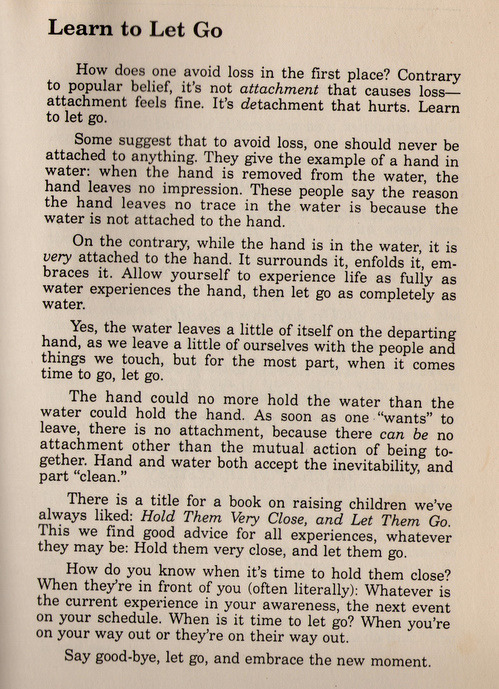
Learn to Let Go

Source of picture: thebeabook

A serious fault of mine is the inability to let go. Be it friendships, relationships or, sometimes, anger. If only letting go were as easy as pulling your hand out of the water or even saying the phrase itself. 

My problems with detachment can only be attributed to the feeling of 'unfinished business' as well as other feelings of being 'forgotten', 'abandoned', and 'lonely'. I often find myself in relationships and friendships that end abruptly, leaving behind only a bitter taste of frustration and confusion. And it is only natural to want to solve the problem and not dwell in sad emotions for too long. A dear friend said to me "No matter what, you're always looking for a conclusion. An answer." I think that is true for most people. Answers are what give people closure, relief and thus, the ability to let go and move on.

Part of my experience in Singapore was to learn, in a healthy manner, how to let go. Of relationships. Of friendships. Of bitter emotions. However, the questions I wanted to ask could not be answered definitively. And sometimes, things will always be unfinished business, no matter how hard you try to find answers for them. The only thing to do - 'When you're on your way out or they're on their way out.' - is to say goodbye right there and then, and not make a fuss. 

But, I can't say that I have completely moved forward from it all. I promise I'm working on it.

Wednesday, May 4, 2011

The Defeats of Trepidation

Source of picture: theparamour
Fear has always been a fascinating concept for me. (Side note: If anyone is generous enough to buy me a copy of The Culture of Fear by Barry Glassner, it would be very much appreciated.) Fear brings out interesting qualities in humans. Why do some of us let this concept hold us by the neck, while others react with such vigour when faced with daunting scenarios? It's somewhat amazing as to what we are capable of doing and feeling when we are faced against our demons.

I'd like to think that I face fear head-on. While I was still in high school, I remember one moment where a Japanese teacher of mine made me and my classmates sit in a circle and mention our strongest qualities - in Japanese. Our teacher gave us an example so we could understand how to structure our sentences and adjectives. The example she used was this:

"I think Sabrina is brave."

I'd never forget the moment when she said that to not only me, but the whole class. (I hope she truly meant it, otherwise this post up to now will be very embarrassing for me.) To this day, it still stands as one of my favourite moments in high school (although, to be frank, there weren't that many to begin with). To my close circle, I've been to known to stick out my neck for those I care about to the point that I am known as the girl who has no fears. (Yes, I'm slightly gushing as I type this out.) But underneath this thin veneer of bravery, at times, there's nothing I feel more than hopelessness. Other times I feel the need to give up because what I'm facing is hurting me too much or I discover that the results aren't going to be worth my struggle.

Some worrying thoughts arise if I find myself in this position. After fear has been defeated, has it truly been conquered - in every sense of that word? What if those same fears arise again? There are moments when I'm tempted to back down and I admit that sometimes, I'm not strong enough to face my demons alone. Defeating my fears once does not necessarily guarantee that those fears will not return and we might think we have overcome the worst of our pains but the courage and strength really lies in how we handle ourselves when faced with the possibility that it could creep back at any time.

So how can the so-called "girl with no fear" brave each trepidation that's thrown her way? I'll tell you this: The biggest fears us mere mortals will ever have to face in our lifetime lies within our minds. Thoughts brought on by our troubles are much more toxic to us than physical harm ever will be. The truly unfortunate thing about fear is that it will never completely disappear but the only 'ammunition' we have to fight with is our own heads. Fight the troubles in your mind, with your mind. Know that something great and worthwhile lies behind each and every single fear. Stay strong and pack your artillery system with hope and faith. We are not powerless. Fight.